Average Vertical Jump by Age and Sex (With Sources)
Active adults 21-30: men about 22 in, women about 14 in by jump-and-reach. Kids by age, college students, elite athletes, and why tests cannot be mixed.
6 min read. Updated November 16, 2026.

Vertical Jump: Train & Measure for iPhone and Android
Pick your target, from touching the rim to a dunk or a volleyball net. Put your phone on the floor and jump: the camera times your flight and shows what is left to your target. Then follow a plan that trains your weakest quality first, with a full test every 4 weeks.


Measuring your jump is free. Plans and offers are shown in the store.
Available in English and German, in inches or centimetres.
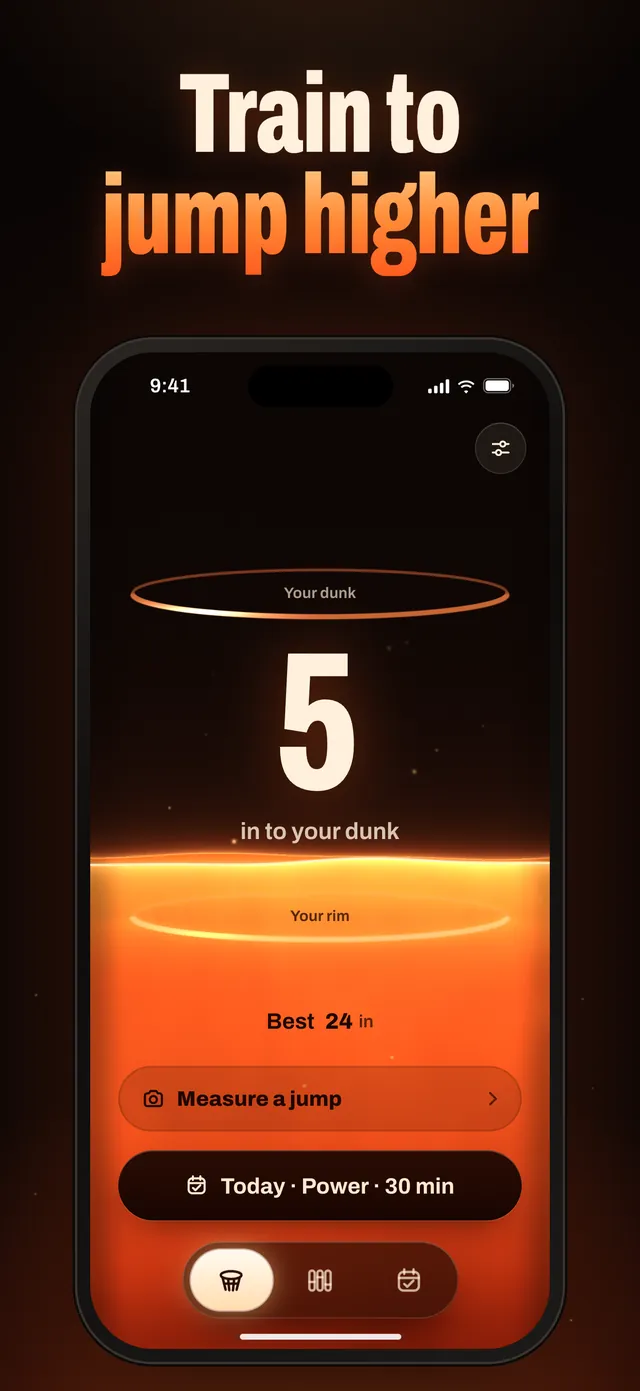
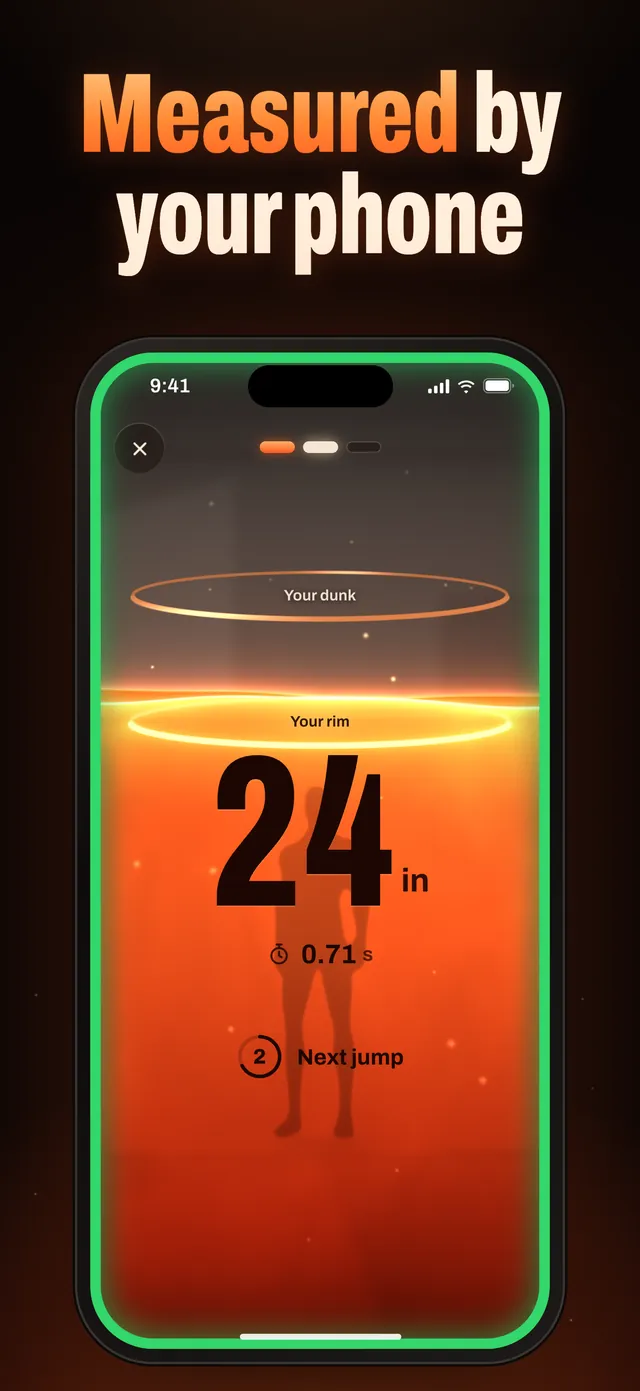
Put the phone on the floor, step back until the frame turns green, and jump. The camera times how long you stay in the air and turns it into a height. Nothing to wear and no chalk marks on the wall.
Your jump profile rates Power, Bounce and Strength. The one that lags becomes your focus and the plan trains it first, in an 8-week programme matched to your level: Foundation, Build or Performance.
Touch the net, touch the rim or dunk on a 10 ft, 9 ft or 8 ft rim, reach over a men's or women's volleyball net, or beat your best. The gauge shows what is left, like "5 in to your dunk".
Every drill comes with sets, reps, a short cue and a moving figure. Rest days sit between sessions, and intense drills such as depth jumps stay locked until you have built the base and passed the landing and mobility checks.
A quick weekly check, and a full test every 4 weeks: vertical, power from a crouch, bounce over 10 hops, a strength self-test, plus landing and mobility checks. The app says when a jump does not count, and why.
Plans and offers can differ between the App Store and Google Play, and are shown in the store before you subscribe.
Active adults 21-30: men about 22 in, women about 14 in by jump-and-reach. Kids by age, college students, elite athletes, and why tests cannot be mixed.
6 min read. Updated November 16, 2026.
32 studies, 818 players: jump training lifted basketball jumps, no adverse effects reported. One- and two-foot drills, rebound bounce and in-season rules.
5 min read. Updated November 16, 2026.
No box? Seven box jump alternatives matched to what the box trains: a hard take-off and a soft landing. Cues, sets and reps, and when each one fits.
5 min read. Updated November 16, 2026.
How to do a box jump: stance, dip, arm swing, soft landing. Pick a box you land on without a deep tuck, step down between reps, and skip 6 common mistakes.
5 min read. Updated November 16, 2026.
Step off, land, rebound at once. Depth jump vs drop jump, box heights of 20-30 and 40-60 cm, the readiness gate, the dose, and what one trial found.
7 min read. Updated November 16, 2026.
In a 12-week calf study, hopping raised three jump types while heavy calf raises raised one. How to use calf raises as support work and what to add.
5 min read. Updated November 16, 2026.
No minimum height to dunk: standing reach is about 1.33 times height. Tables by height from 5 ft 4 to 6 ft 8 and by reach, with the vertical you need.
7 min read. Updated November 16, 2026.
Dunking is a ladder: measure your gap, raise your jump, fix the last two steps, climb from a tennis ball to a full ball, and finish one-handed first.
6 min read. Updated November 16, 2026.
Jump higher by training force and speed together, then fixing arm swing, dip and run-up. The 5 levers, the study numbers behind each, and how to test them.
7 min read. Updated November 16, 2026.
20 lower-body plyometric exercises in four intensity tiers, each with a cue, sets and reps, and what it trains. Plus the landing-force surprise.
7 min read. Updated November 16, 2026.
Long static stretches cost about 4.6% of performance; dynamic moves add 1.3%. An 8-minute plyometric warm-up, timed step by step, plus a re-warm.
4 min read. Updated November 16, 2026.
New to plyometrics? Pass three readiness checks and a 5-point landing test, then run two weeks of low drills at 40 to 60 contacts, twice a week.
5 min read. Updated November 16, 2026.
Pogo hops train short, springy ground contacts under about 250 ms. The cue, the 10/5 hop test, why its two formulas disagree, and a five-step progression.
5 min read. Updated November 16, 2026.
One-leg jump training raised one-leg jumps far more than two-leg work in a volume-matched trial. Seven single-leg drills, doses and the readiness check.
4 min read. Updated November 16, 2026.
A run-up added 10 to 15 cm (14.5-20%) in 3,610 basketball draft prospects measured by reach. Definitions, averages and the last-two-steps technique.
5 min read. Updated November 16, 2026.
Squats added 3.3 cm, jumps 3.8 cm, both together 10.7 cm in one 6-week trial. The lifts, loads, session order and who should lift first to jump higher.
6 min read. Updated November 16, 2026.
An 8-week, no-equipment plan to train your vertical jump at home: two 20-30 minute sessions a week, a bodyweight strength ladder and a way to measure.
5 min read. Updated November 16, 2026.
10 exercises to jump higher, ranked by evidence: countermovement jumps, target jumps, squats, lifts, single-leg work and more. Pick by your weak spot.
6 min read. Updated November 16, 2026.
Studies show 5-9% gains over 6-12 weeks while your jumps vary 2.4-4.6% try to try. How to tell a real plateau from noise, its six causes and a checklist.
5 min read. Updated November 16, 2026.
Wall touch, vane device, contact mat or phone video: how each vertical jump test works, why they disagree, and a 3-jump home test you can do right now.
5 min read. Updated November 16, 2026.
Three printable 8-week vertical jump plans: no equipment, box and dumbbells, or gym. How to pick your level, what each week holds and when to test.
9 min read. Updated November 16, 2026.
Three vertical jump workouts with sets, reps and rest: no equipment, box and dumbbells, or gym. How to order a session, how many jumps, and when to stop.
7 min read. Updated November 16, 2026.
Jump training gave volleyball players a moderate gain across 14 trials, even at low volume. Drills, approach and block footwork, and counting your jumps.
5 min read. Updated November 16, 2026.
Plyometrics means jumps that use a quick stretch, then a push. Fast vs slow contacts, why a dip adds height, and what training changes, with the studies.
5 min read. Updated November 16, 2026.
Put your phone on the floor, step back until the frame turns green, and jump. The camera times how long your feet are off the ground, and the app converts that flight time into a jump height. You do not need a wall, chalk or a mat.
No. The video is analysed on your phone and never saved or uploaded. Your jumps, your plan and your progress are stored on your device, and there is no account to create.
The app rejects a jump when you leave the frame, tuck your legs in the air or land with bent knees, because each of those changes the flight time. It tells you which one happened so the next jump counts.
A level questionnaire places you in an 8-week programme: Foundation, Build or Performance. Each week has guided plyometric and strength sessions and a quick check. Weeks 4 and 8 end with a full test, and the focus follows the quality that lags.
Yes. Pick a men's or women's volleyball net as your target, or simply beat your best. The approach lesson has a volleyball variant, and the plan's technique work changes with your goal.
Measuring your jump is free: the three-jump test, your result and your record. The plan, the profile, the full test, sessions and progress come with a subscription. Plans and offers are shown in the store before you subscribe.
English and German, with heights in inches or centimetres.
Jump higher. Your phone keeps the score.
Wellness app, not a medical device and not medical advice.
Vertical Jump is made by EASYTECH, an independent app studio in Annecy, France. Privacy policy · Terms of use. For iPhone and Android.